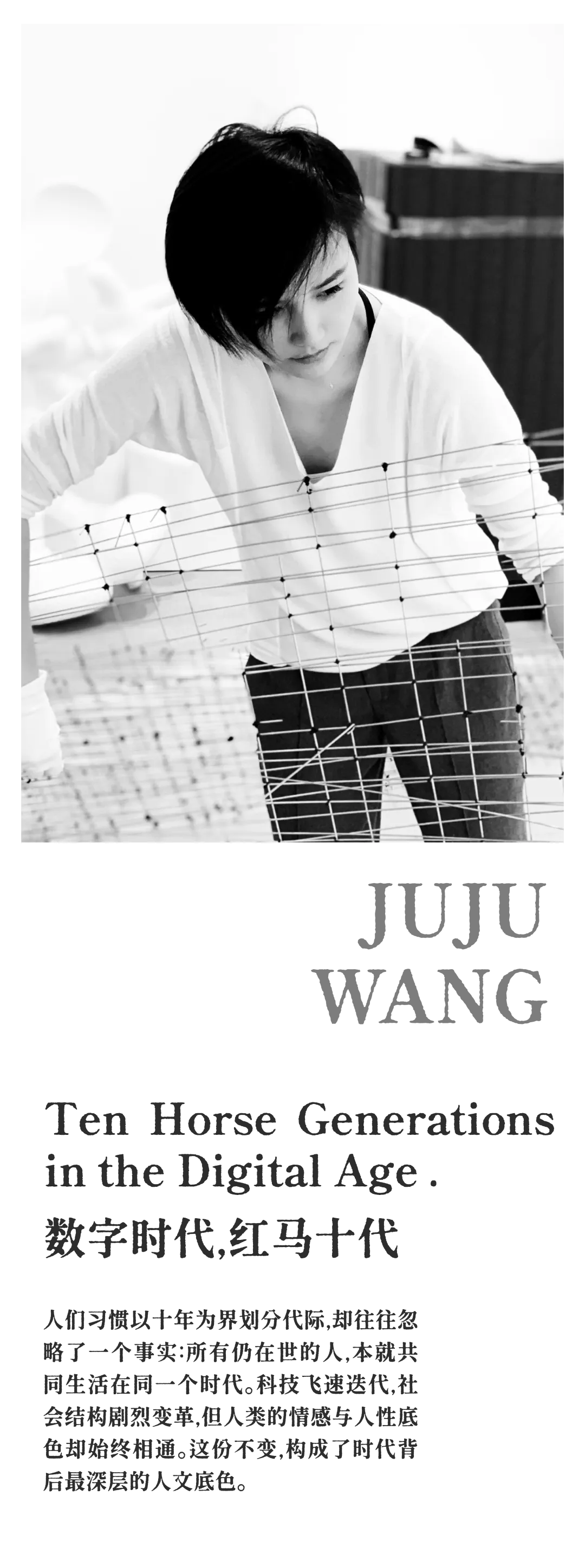
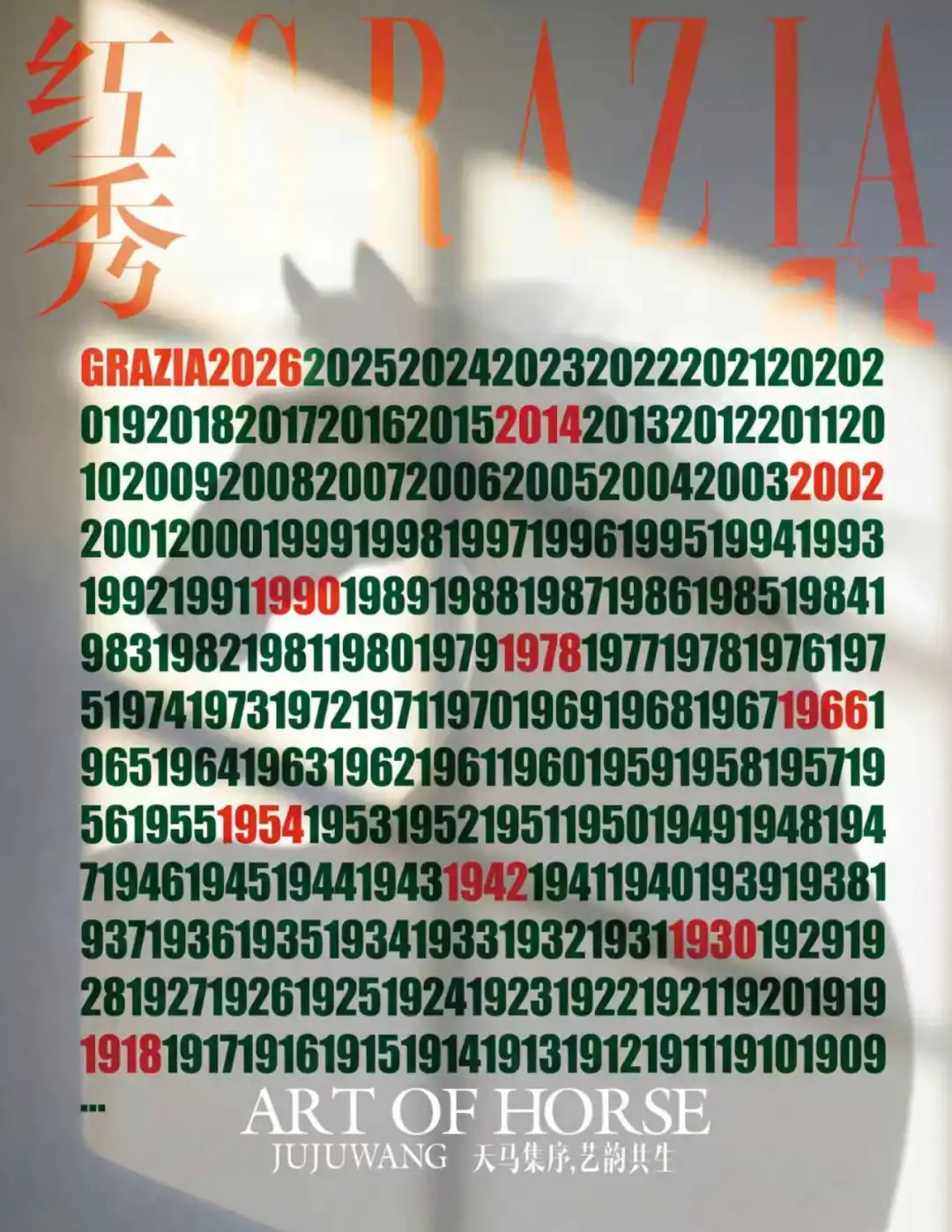
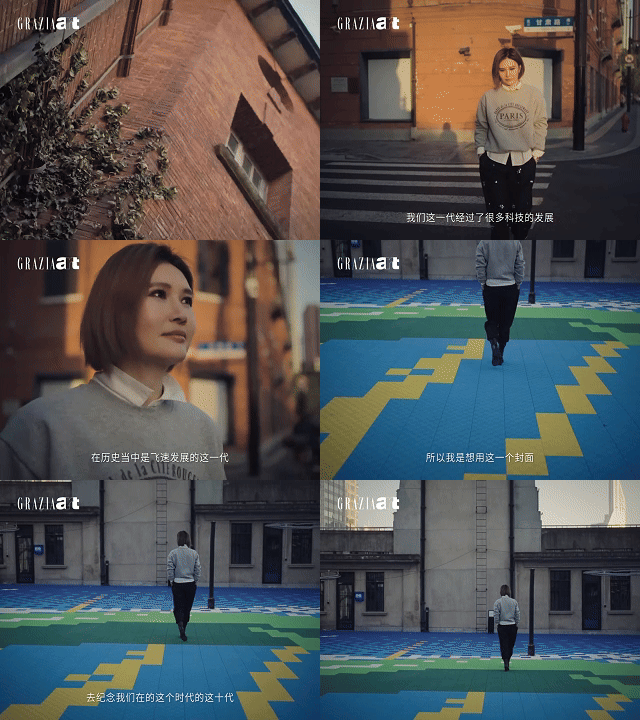
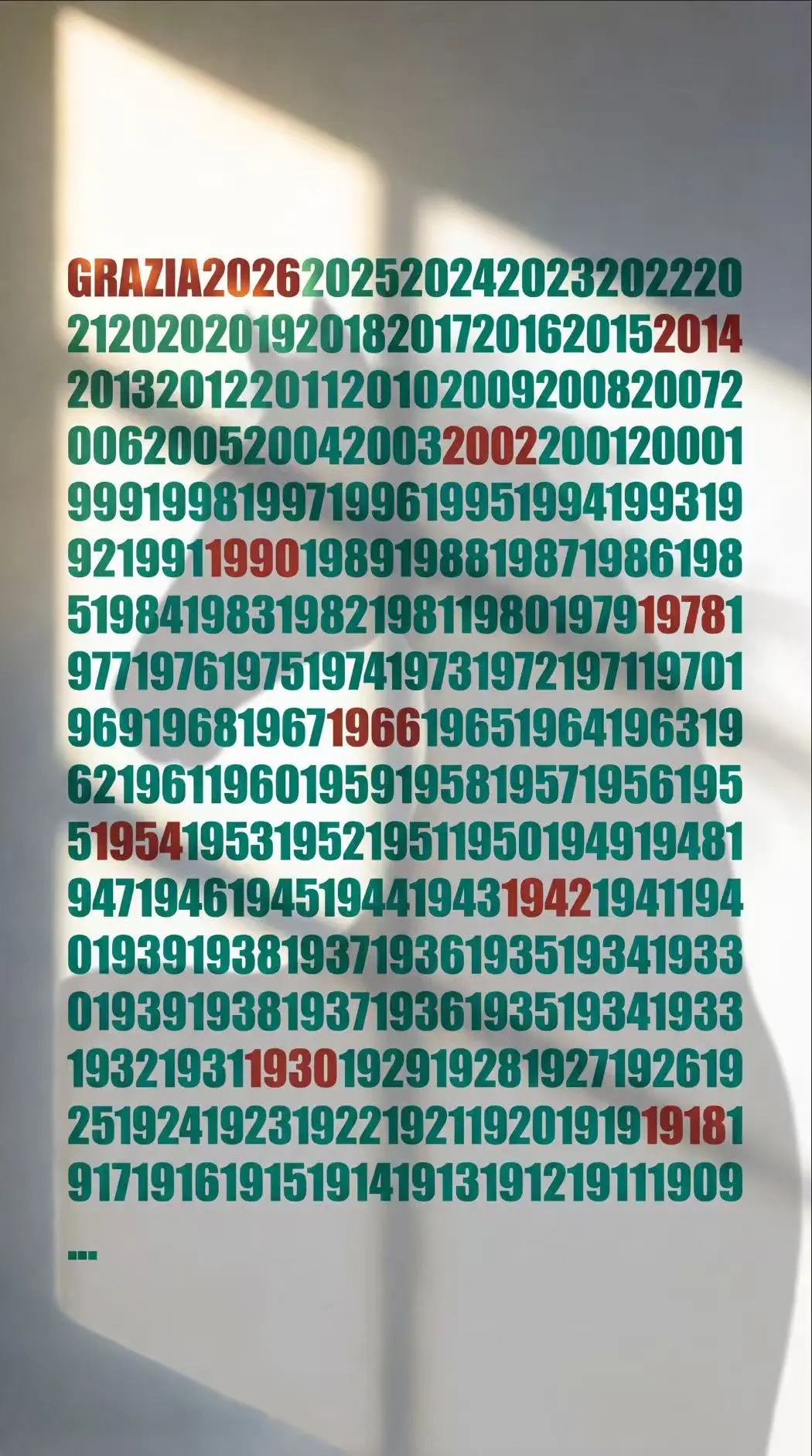
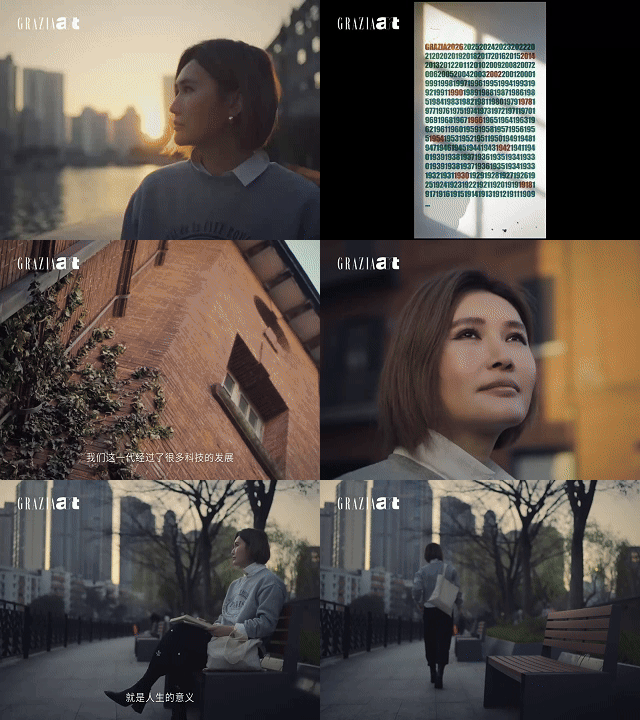
Installation artist JUJUWANG’s Year of the Horse creation is a dialogue about time and generations. Her AIGC digital work Era (Ten Generations) depicts our world through an abstraction of individual experience—years are sequentially arranged, spanning from 1909 to 2026, representing the collective years of all living humanity to date. We are the generation currently inhabiting Earth, collectively forming a timeline spanning over a century.
Within this piece, JUJU merges two symbolic representations of the “horse.” All years corresponding to the Year of the Horse are highlighted in red. In traditional Chinese zodiac culture, one’s birth year is regarded as requiring special protection. This gave rise to folk customs of wearing red and tying red strings, using the positive energy of red to ward off evil and avert disasters. JUJU transforms this uniquely Eastern cultural memory into visual language, with flowing red symbols embodying her wishes for those born in the Year of the Horse to enjoy smooth progress, health, and good fortune in the new year. Elsewhere in the composition, a galloping steed pauses mid-stride, its gaze fixed upon the viewer. This lingering look carries a profound sense of space, as if the horse were reflecting upon the myriad phenomena of the human world from the flowing river of time.
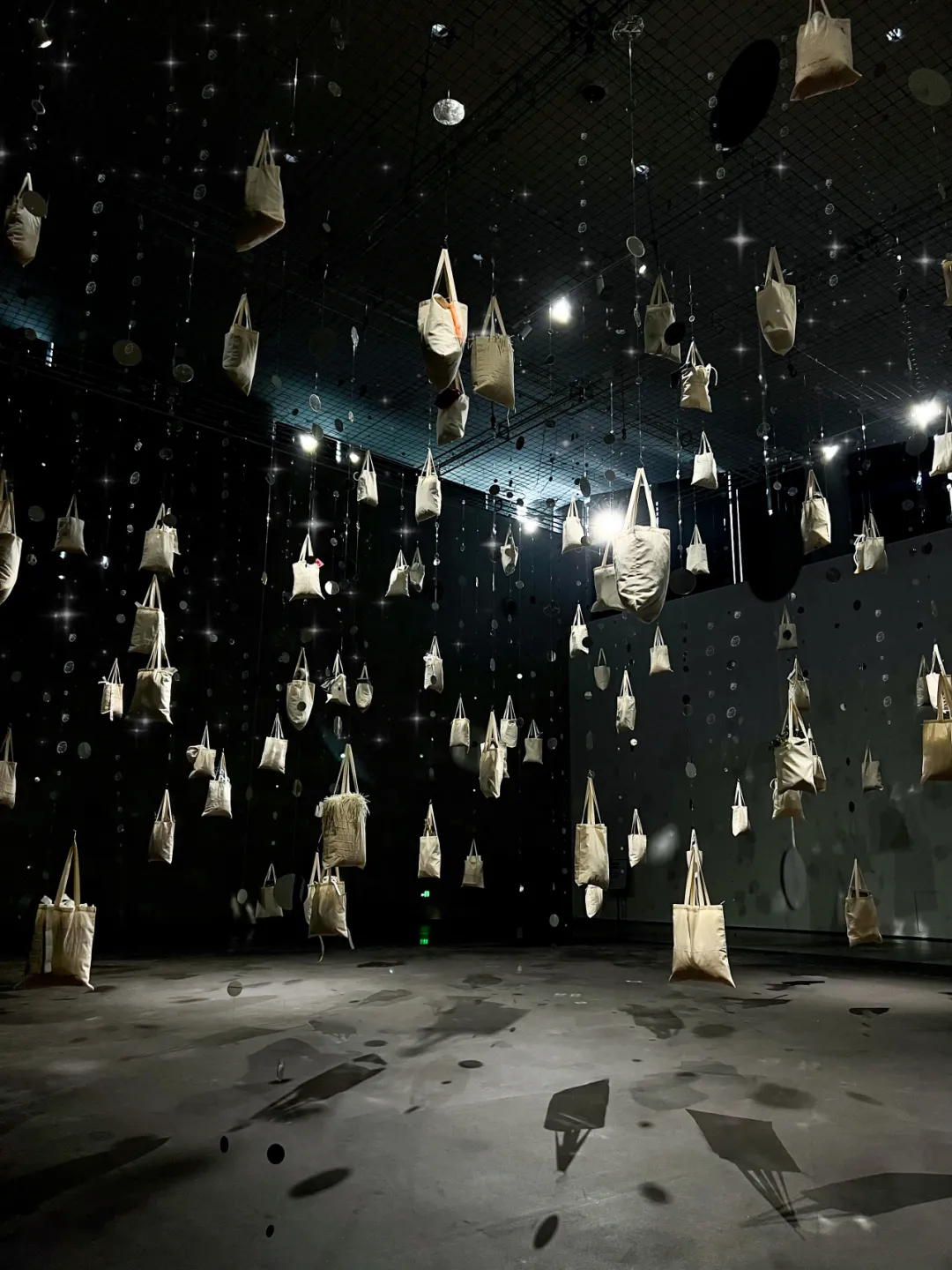
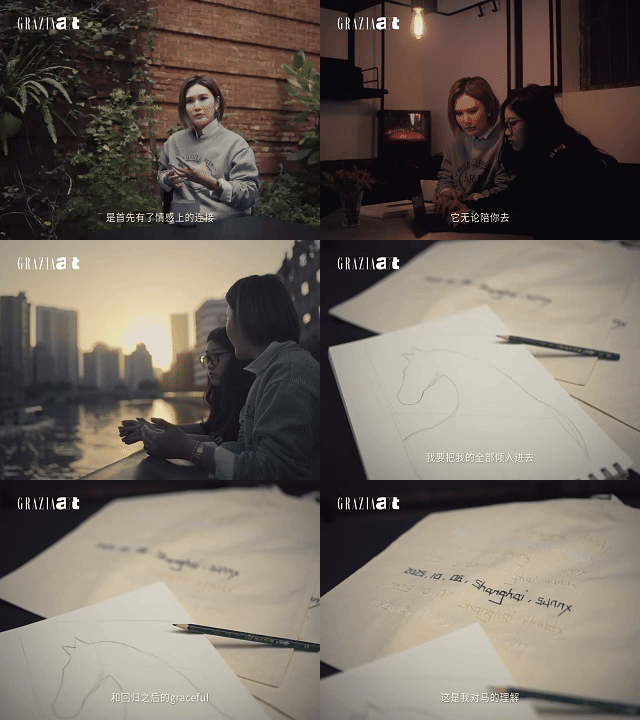
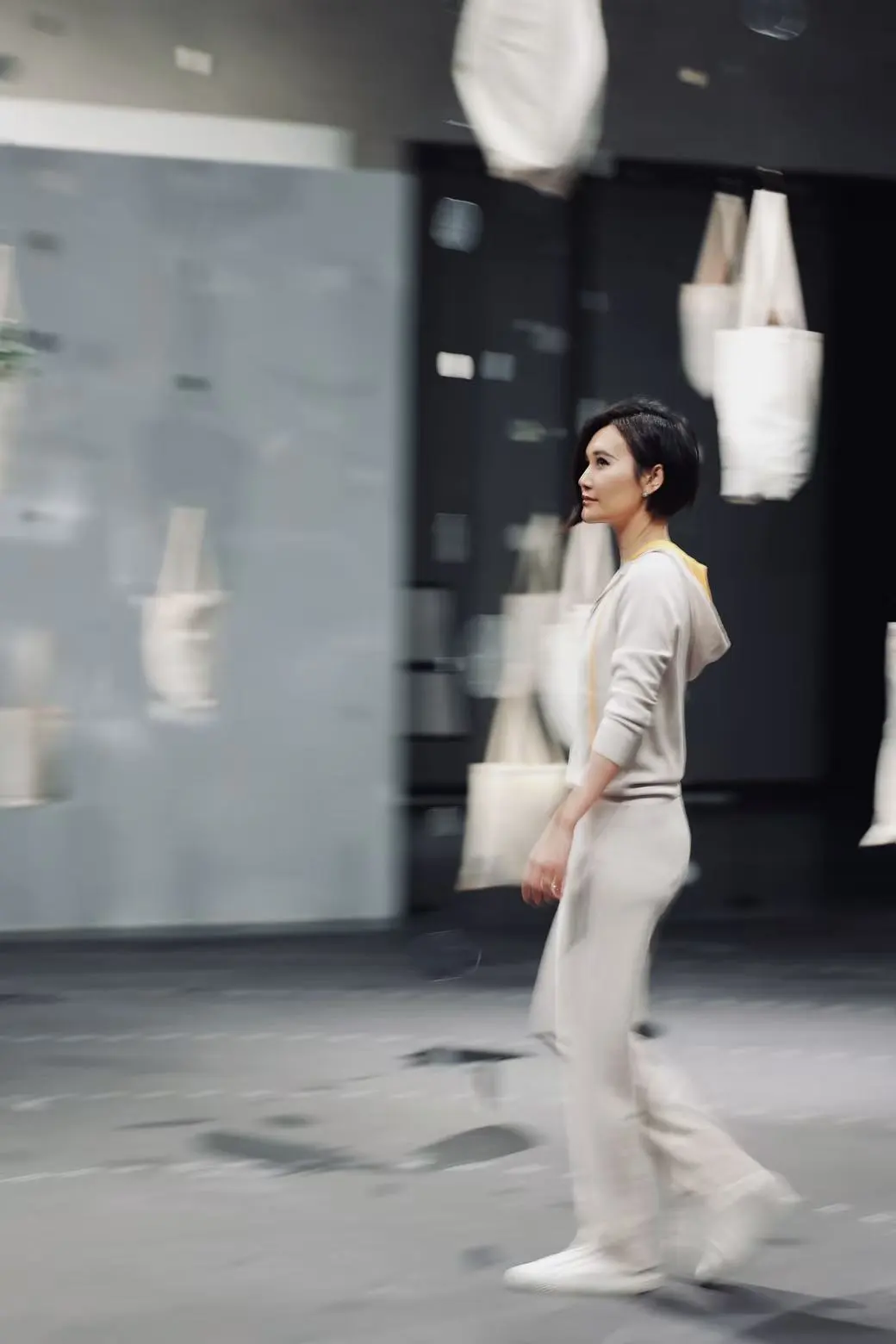
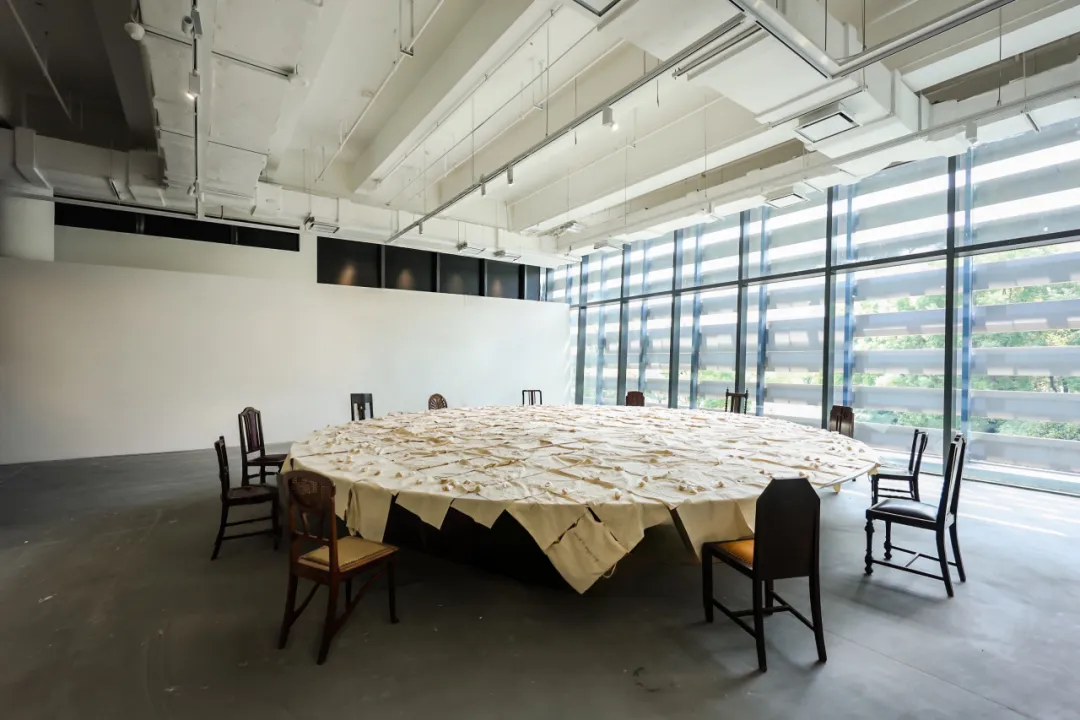
Time and nature are recurring themes JUJU WANG revisits in her creations. Her works resemble not isolated atoms, but rather continuous practices imbued with the passage of time. This digital work draws inspiration from her earlier project, The Same New Days. In that endeavor, she documented her existence and the world around her on a weekly basis: each day, JUJU embroidered the date, city, and weather onto the canvas bag she used that day. At the end of each week, she added text and images to record one memorable event that occurred globally during that period.
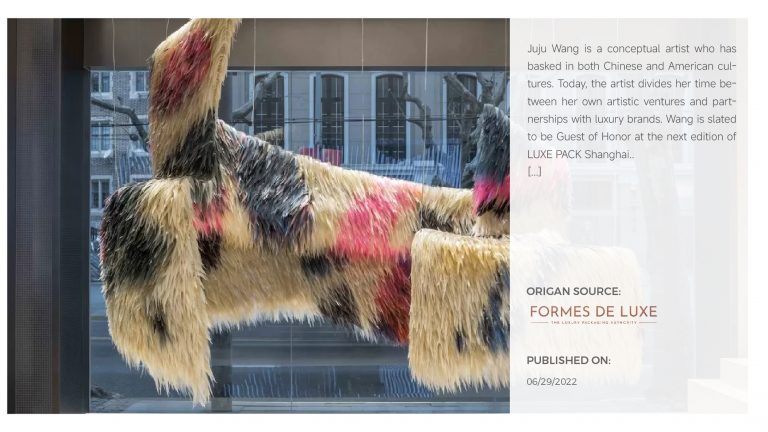
This project has persisted for six years. While its form has evolved, the practice of hand-embroidery remains constant. For JUJU, completing an artwork is not merely about expressing an idea—it is the result of the body’s active participation. Thus, even amid the rapid advancement of AI technology, she steadfastly upholds the warmth of handmade craftsmanship. Simultaneously, JUJU actively explores new media, integrating AI into her creative system to foster dialogue and coexistence between emerging technology and her established experience.

In recent years, another more personal yet equally significant thread has quietly emerged in JUJU’s work—her experience as a mother. Her daughter’s growth has brought new perspectives, subtly shaping her understanding of imagery, time, and expression. What began as playful documentation—capturing everyday moments with a phone: small gestures, fleeting emotional shifts, raw fragments of reality—evolved. Through continuous experimentation, the child developed a fascination with short videos and began actively learning the platform’s expressive language—editing rhythms, visual transitions, and the interplay of music and emotion. When these videos were uploaded to social media, the likes and interactions from strangers became an immediate, tangible feedback mechanism. For the first time, she realized that images could be “seen” and responded to. Traffic was no longer just abstract data but a genuine way to engage with the contemporary visual landscape.
For JUJU, her child’s daily short videos became another window into contemporary visual culture. They eschewed grand narratives yet precisely captured the operational logic of today’s visual culture: lightness, speed, and emotion preceding meaning.
Through her daughter’s practice, JUJU gained a more contemporary perspective to reinterpret how images are produced and disseminated in daily life, and how they generate influence within fragmented temporal structures. As a mother gains fresh perspectives and insights from her child’s growth, time ceases to be merely a linear flow and instead forms a cycle of feedback and nourishment. This experience deepens JUJU’s conviction: time is not only about the future’s trajectory but also about clarifying everything we experience in the present.
As the Year of the Horse approaches, the work Era (Ten Generations) serves as a gentle yet resolute reminder: in an era galloping forward, understanding, reflection, and mutual recognition remain equally vital.